Start with your scan.
Your history, consent and retinal photographs create the starting point. A quality check confirms whether the images are suitable for analysis.

Discover the science of retina age. Use retinal insight to build a more informed approach to daily life, guided by clinicians.
Explore your retina ageYour chronological age counts the years. Retina age is an AI estimate of how old your retina appears, based on patterns in a photograph of the back of your eye.
The difference is called the retinal age gap. Research is exploring what it may reveal about ageing and health risk. It is a starting point for a conversation, interpreted alongside your medical history and established health checks.
Explore the evidenceA younger appearing retina is an observation to discuss in clinical context. It does not rule out disease.
Explore the concept using the slider. These are fictional values, not a test or assessment. A real estimate requires suitable imaging and a validated model; availability is subject to clinical validation.
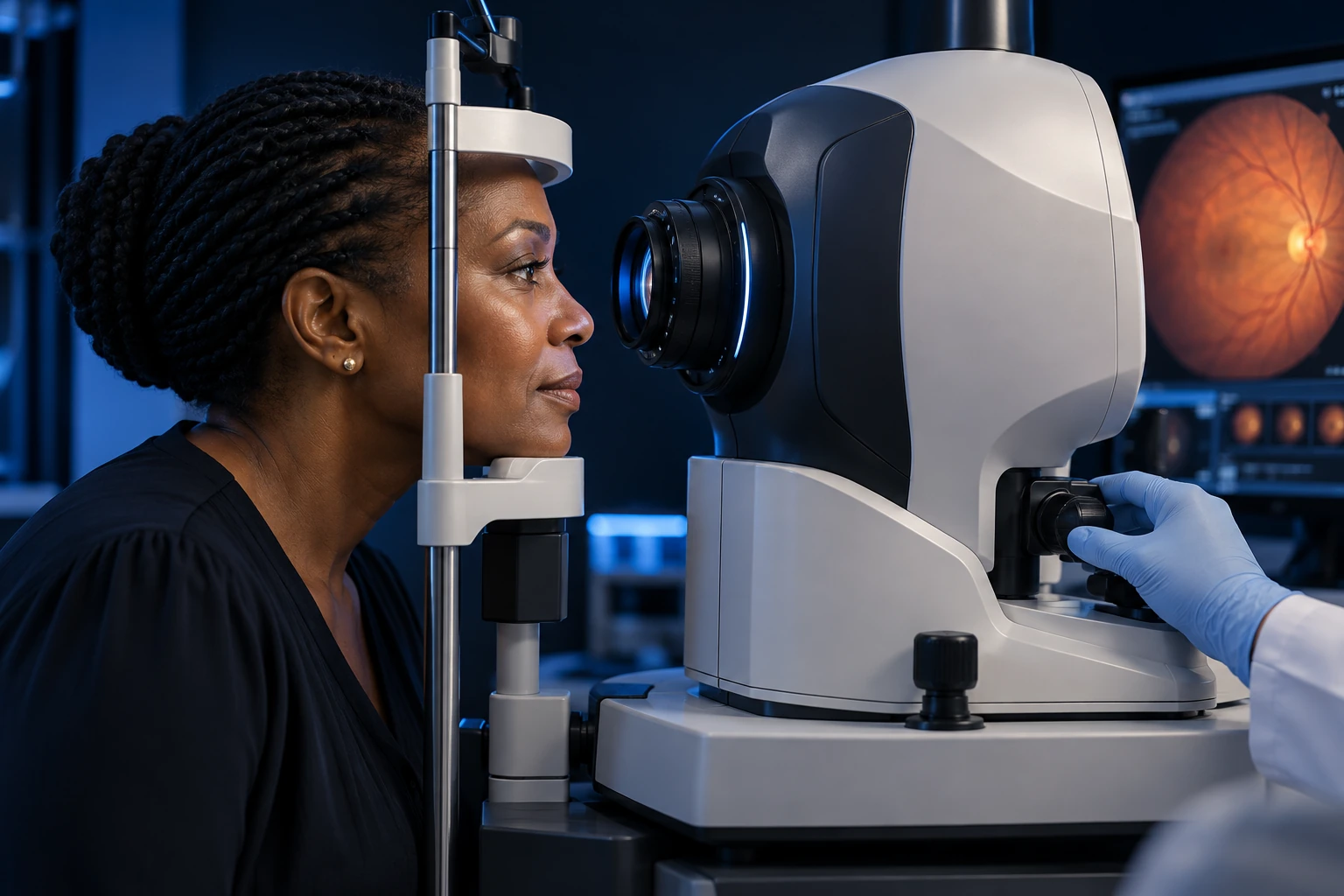
Explore the steps that turn a retinal photograph into information a clinician can interpret.
Focus, lighting and retinal coverage are checked. If the image is not suitable, a repeat capture or a different assessment may be needed.
The ONEMED approach starts with scans, then connects findings to the right clinical conversation.
Your history, consent and retinal photographs create the starting point. A quality check confirms whether the images are suitable for analysis.
Images are checked for focus and coverage. Suitable images enter the relevant analysis pathway; poor quality images may need to be retaken.
Clinical review considers retinal findings alongside your history. Any AI output supports interpretation within its validated scope.
A clear explanation helps distinguish routine follow up from findings that need further assessment or referral.
Your clinician advises when to repeat imaging and which established health measures to monitor between visits.
Before imaging, discuss relevant history and understand consent, the scan’s scope and how results will be explained. Select a stage above to explore.
The retina is light sensitive tissue at the back of your eye. Its visible blood vessels give clinicians an opportunity to examine changes that may matter for eye health.
Retinal imaging can complement broader care. It does not replace blood tests, blood pressure checks or a comprehensive eye examination.
See how insight connects to careLight captures the starting point. Image quality comes first.
CONCEPTUAL ANIMATION · NOT A CLINICAL SCAN

Insight becomes meaningful through practical choices, ongoing care and time. Build a routine that fits your life and the advice of your care team.
Explore your everyday foundationsLiving according to retina age means using insight to ask better questions and agree meaningful priorities with your clinician.
Build a balanced eating pattern around your health needs. If you have diabetes or other conditions, agree dietary changes with your care team.
Choose regular activity suited to your fitness and medical history. A safe, sustainable routine matters more than chasing a score.
Keep up with blood pressure and glucose checks, prescribed treatment and eye care appointments. Discuss tobacco use and sleep with your clinician.
Track established health measures and follow up recommendations. Repeat retinal imaging at a clinically appropriate interval.
A simple reflection tool, inspired by the foundations above. Tick what you made space for today. This is not a health score or a retina age treatment plan.
Selections stay only on this page and clear when you reload. No health data is sent or saved.
No specific diet, supplement or procedure is proven here to reduce your retina age. Treatment decisions require an individual clinical assessment.
We believe useful health insight starts with clear explanations: what a scan can tell you, what remains uncertain, and what happens next.
Read the retinal age studyNo. It is a model derived estimate from retinal images. It is being studied as a potential ageing biomarker, rather than a complete measure of your body's age. Results depend on the model, image quality and population.
No. Research has found population level associations between retinal age gap and mortality. These associations do not predict an individual's lifespan or prove that changing the score changes outcomes.
Retinal assessment can help identify signs of eye disease, including diabetic retinopathy, which may have no early symptoms. The camera, imaging protocol and clinical review determine what can be assessed. A scan cannot exclude every condition.
ONEMED's initial focus is retinal scanning and the pathway from imaging to clinical interpretation and appropriate follow up. Retina age reporting requires a clinically suitable, validated service. Broader ecosystem features are future development, not current services.
Discuss it with a qualified clinician. Do not change medicines or start supplements based on an age estimate. Sudden vision loss, a curtain over your vision or new flashes and floaters need urgent eye assessment.
Explore how a scan first approach could fit into your health journey, or learn about ONEMED's proposed screening pathway for your organisation.
Scan first programme · Service details and availability to be confirmed